Sunday, January 5, 2020

Chalk Outline Mystery

 Chalk outline detailing position of head with knife in hand. LAPD/Fototeka, 1950 via Huffington Post

Growing up in San Francisco in the 1970s I went on many school field trips. One of them made quite an impression. While walking around the outside of the Academy of Sciences, a museum located in Golden Gate Park, we saw the white outline of a body on a tree-shrouded path. For some reason at the time I believed this was the outline of a jumper. Regardless, I never forgot it and, since the arrival of the internet, have periodically Googled it to see if I can find who had jumped off the roof of the museum.

Last week I remembered having seen the chalk outline and Google it once again. However this time I learned about artist Richard Hambleton's Image Mass Murder.


Postcard of Hambleton’s Image Mass Murder 1976-1979 via Gallery 98                       //     via Woodbury House Art

In 1976 Richard Hambleton moved to San Francisco to attend the SF Art Institute. He made Image Mass Murder soon thereafter. It was a series of site specific artworks, created from 1976 to 1979 under the pseudonym Mr Reee, in which he asked friends to lie down and he'd trace their outlines in chalk and splatter red paint on them to emulate homicide victims. Hambleton's series "resulted in 600 crime scenes on the streets of 15 major cities across the United States and Canada." 1

 Outline on a Vancouver sidewalk by the street artist R. Dick Trace-it, 1977, via Woodbury House Art

"It was on the front page of the San Francisco Examiner in December, 1976, that Hambleton was called a “psychic terrorist” and a “sick jokester” for his fake murder scenes."2 The police did not know at the time they were dealing with an artist. Hambleton also used the pseudonym R. Dick Trace-It for the "detective" "solving" the crimes using "Wanted" posters for fake felons.

I ask myself, is it possible the outline I saw in Golden Gate Park that day was a Richard Hambleton artwork? I am reminded that while chalk outlines are no longer used by police today, but they were common in the past. But who would jump off of a two story museum? The mystery persists and my search continues for someone who may have documented the locations of Hambleton's Mr Ree works in San Francisco in the late '70s.
 Weegee, Outline of a Murder Victim, 1942 via Met Museum


1. Spellman Gallery
2. Vancouver Sun Obituary 2017

Sunday, December 1, 2019

Love is liking ideas.


Charles M. Schulz
Dear Reader, 

I want to tell you that everything will be okay.
I want to tell you that it will get better.
I want to tell you that it all works out in the end. 

But sometimes it doesn’t. 

Most times it is hard and we usually end up getting used to it. 
But there is something you can do in response: read. 

Read until your heart breaks and you can’t stand it anymore.
Read until you have paper cuts from turning pages or blisters from swiping a screen. 

You see, here’s the thing: even at their worst, books won’t abandon you. 
 If they make you cry it’s only because they are that good. 

You can depend on books. 
They will always be there for you. 
Their patience is infinite and they have been known to save lives. 
They can help you become a smarter, more interesting person.

 Embroidery by Sarah K. Benning

Books can probably help you get dates, 
though I don’t recommend you ask that much of them too often 
(you don’t want to limit their power). 

Books — like dogs — are among a handful of things on this planet that just want to be loved. 
And they will love you back, generously and selflessly, requiring very little in return — until they are complete, their light and their wisdom and their hearts sputtering to an inevitable, lonely end. 


Sunday, February 17, 2019

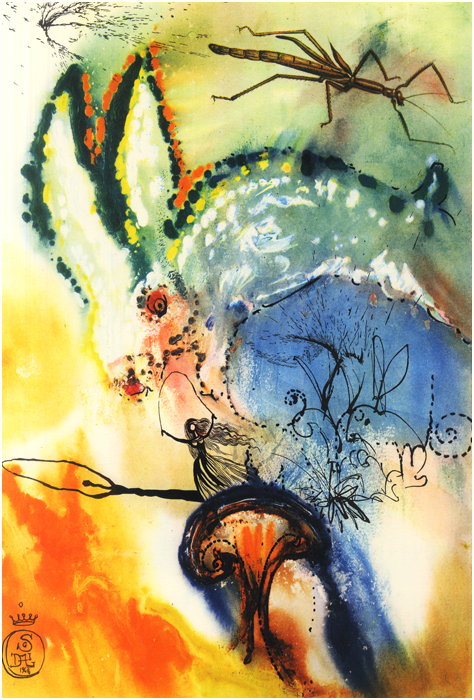
Dali Does Alice

When I was a girl I was a stage actor. I played Alice in a production of Alice in Wonderland. This led to decades of collecting Alice books and ephemera.

I have a number of editions by wonderful illustrators, including Ralph Steadman and Barry Moser, but had never heard of the ones by Salador Dalí. What a lovely surprise to stumble across these vibrant images from an edition published by Maecenas Press-Random House in 1969. The set includes 12  heliogravures  - one for each chapter of the book. It was printed in a limited edition of 2500 copies.


Thursday, January 31, 2019

Old Age Advice


Writer Grace Paley told a story about getting advice from her father on growing old.
My father had decided to teach me how to grow old. I said O.K. My children didn’t think it was such a great idea. If I knew how, they thought, I might do so too easily. No, no, I said, it’s for later, years from now. And besides, if I get it right it might be helpful to you kids in time to come.

They said, Really?

My father wanted to begin as soon as possible.

[…]

Please sit down, he said. Be patient. The main thing is this — when you get up in the morning you must take your heart in your two hands. You must do this every morning.

That’s a metaphor, right?

Metaphor? No, no, you can do this. In the morning, do a few little exercises for the joints, not too much. Then put your hands like a cup over and under the heart. Under the breast. He said tactfully. It’s probably easier for a man. Then talk softly, don’t yell. Under your ribs, push a little. When you wake up, you must do this massage. I mean pat, stroke a little, don’t be ashamed. Very likely no one will be watching. Then you must talk to your heart.

Talk? What?

Say anything, but be respectful. Say — maybe say, Heart, little heart, beat softly but never forget your job, the blood. You can whisper also, Remember, remember.

via BrainPickings / Image CC BY-NC-ND 2.0 via Elise Feliz

Saturday, September 16, 2017

Harry Dean Stanton

I had the immense pleasure of watching Harry Dean Stanton: Partly Fiction on a plane over the holidays a few years back. I took notes....

David Lynch: How would you describe yourself?
Harry Dean Stanton: As nothing. There is no self.

David Lynch: How would you like to be remembered?
Harry Dean Stanton: Doesn't matter.

David Lynch: What were your dreams as a child?
Harry Dean Stanton: Nightmares.
   
My old man used to say, go straight ahead until you hit something.

I've avoided success artfully

It's all gonna go away. You're gonna go. I'm gonna go. The sun's burning out. The earth is going to go. It's all transient. Everything is transient, so it's ultimately not important. It's all fleeting. Passing. But it's liberating. Just everything happens. It's one connected whole that's happening. That's the Buddhist take but I'm not a Buddhist.

David Lynch: What are you?
Harry Dean Stanton: I'm nothing. When you're nothing there's no problems.


Tuesday, January 3, 2017

Get Busy Living

Actress Elsie Ferguson by Baron de Meyer, c.1921.
The evening chant at the end of the last sitting in a Zen temple: Let me respectfully remind you, life and death are of supreme importance. Time swiftly passes by and opportunity is lost. Each of us should strive to awaken. Awaken. Take heed. Do not squander your life.

Sunday, July 17, 2016

A Taste of Brooklyn History

“We mark ourselves by what we choose of our past to shield from the churn of change. Much of this, whether an old building or historic landscape, is lasting and durable by definition. That something as soft and perishable as cheese should make it across 75 years of time and space, outlasting brick and mortar — indeed, much of the city — is beyond remarkable.”
A bit of Brooklyn history told through the story of a round of cheese. Delightful!
“I returned to the city with the edible heirloom that was most likely made from the milk of sheep that grazed on the Lazio plain as fascism gripped Italy and Europe descended into war; that crossed an Atlantic harried by U-boats; that dodged the wrecking ball of urban renewal and survived even suburbia; that was finally, safely home.”
Don't miss reading the full piece in the New York Times by Thomas Campanella, a professor of city planning at Cornell University and author of the forthcoming “Brooklyn: A Secret History.”

Sunday, June 5, 2016

Invasion

San Francisco is being transformed by big tech companies moving their headquarters to the City. For those of us who grew up in SF, the changes are hard to swallow. In my opinion, it is not simply a growing income equality that is what troubles folks. Rather it is the change in cultural values that is hardest to accept. It seems as if those working in the tech industry are drones, working in a value system that simply hopes to "cash in" one day. As a commenter on this blog points out, it's simply speculation. San Francisco's values have not been so much about achieving financial wealth, but rather about living life with political and cultural integrity.  This is why the animosity to the tech workers is so great. In any case, I recently watched Invasion of the Body Snatchers (1978) and found it eerily speaks to the change San Franciscans are experiencing today.

Thanks for watching my first video.

Goshka Macuga: Time as Fabric


It's hard not to be impressed by Goshka Macuga's tapestries on view at The New Museum (on view through June 26, 2016). The scale, detail, and sophisticated production are impressive. -- literally and figuratively. Macuga did not weave these hangings herself; they were produced by the Belgian weaving firm Flanders Tapestries.


My husband and I argued over the artist's lack of personal craftsmanship, however there is a long history of artists designing (but not making) tapestries: Raphael (16th century),  Edward Burne-Jones (1890s), Fernand Leger (1920s), Joan Miró (1930s), Henri Matisse (mid-century), Alexander Calder (1960s) plus many others. Today, Magnolia Editions in Oakland, Ca produces Jacquard tapestries for artists such as Chuck Close and Alex Katz.

Tapestries have been woven for thousands years all over the world. In Europe during the Middle Ages, weaving became a highly respected artistic medium. Tapestries flourished due to the Church's patronage. And for the wealthy, a tapestry was one of the most prestigious items one could own. However, during the Renaissance, oil painting started to displace tapestry as an elite form of artistic creation. The notion of the individual artist was gaining standing over the labor of craftsmanship, creating a hierarchical division between tapestry weaving and painting. (And religious persecution disrupted leading centers of high-quality production dominated by the workshops in Brussels, dispersing a pool of highly talented weavers.)

The decline of tapestry persisted until the end of the 19th century when it enjoyed a renewed attention due to the Arts and Crafts Movement helping to revive interest in traditional craft processes, utilitarian artistic production, and the link of artists with industry. With industrial, automated processes on the rise, tapestry became a means to challenge the hierarchical position of painting and elevate materials that were seen as humble or everyday. In 1915, Jean (Hans) Arp exhibited a series of tapestries, noting in the exhibition catalogue that:
“These works … keep a hostile distance from egotism. They are hatred of the immodesty of human baseness, hatred of images, of paintings." 1.
Arp was strongly anti-elitist and chose the medium of tapestry very deliberately. “Arp had an idealized view of the anonymous pre-Renaissance artist, for whom the division between applied and fine art was irrelevant.” 2. Yet despite his call for egalitarianism, the weavers weren't named; only Arp was.

 Hans Arp, Untitled (Diagonal Composition-Crucifixion), 1915. Private collection.

But weavers weren't consistently invisible actors in the production of art tapestries. 3. The author Jean Lipman explains in Calder's Universe that while Calder designed the cartoons for his tapestries and had wool dyed to his specification, the weavings themselves were true cooperative ventures.
"... both Calder's signature and the weaver's trademark are woven into the fabric ...The tapestry medium...is an example of the successful collaboration with skilled craftsmen that has characterized Calder's later years ...The weaver follows Calder's forms exactly but improvises to vary the weaves and textures in a free interpretation of the overall design. The tapestries are fresh works of art in their own right, blending the inventiveness of the artist with that of the weavers." 4.

So back to Goshka. Useing appropriation to warp and weave histories together, she arranges disparate elements to form a new narrative. To argue whether an artist should make every work themselves seems outdated and outmoded in this post-Duchampian era. Of course artists don't have to make their own work anymore! You think Tara Donovan, Jeff Koons, or Tom Sachs make their own artworks? Of course not. That being said, it wasn't easy to track down the name of the weaving studio that made Goshka's magnificent pieces, and that isn't right. The tapestry manufactories of the past are renowned now (Arras, Aubusson, Beauvais, Bruges, Felletin, Gobelins, Oudenaarde). Today's manufacturers also deserve credit, for these massive tapestries are a collaborative feat!


1. Eric Robertson, Arp: Painter, Poet, Sculptor, Yale University Press; 1st ed edition (2006), page 33
2. Bibiana Obler, Intimate Collaborations: Kandinsky and Münter, Arp and Taeuber, Yale University Press (2014), page 126.
3. A number of the Soho Tapestry Weavers were named (18th century).
4. Jean Lipman, Calder’s Universe, exhibition catalogue, New York: Viking Press in cooperation with the Whitney Museum of American Art (1976), page 157.

Saturday, February 13, 2016

On Solitude

Do not underestimate the power of alone time:
No sooner am I alone than shapes of epic greatness are stationed around me, and serve my Spirit the office which is equivalent to a King’s body guard… I melt into the air with a voluptuousness so delicate that I am content to be alone… I have written this that you might see I have my share of the highest pleasures and that though I may choose to pass my days alone I shall be no Solitary… I am as happy as a Man can be… with the yearning Passion I have for the beautiful, connected and made one with the ambition of my intellect. ~ John Keats

| Eva Hesse with a rope sculpture, Hermann Landshoff c.1969 | Gerhard Richter, Eis (“Ice”), 1981. Photo: Sotheby’s. |
| Alex Coleville, Man on Verandah, 1953, glazed tempera. Private collection, Germany |


“I must be totally engrossed in my own work, it is only thing that is permanent, matures and is lasting.”  ~ Eva Hesse in Eva Hesse: Longing, Belonging and Displacement by Vanessa Corby, 2010.

Richter's Eis was based on a photograph taken on a solo retreat in Greenland in 1972.

Colville's haunting works are structured around the essentially solitary nature of human experience.

"I believe I know the only cure, which is to make one’s center of life inside of one’s self, not selfishly or excludingly, but with a kind of unassailable serenity — to decorate one’s inner house so richly that one is content there, glad to welcome anyone who wants to come and stay, but happy all the same when one is inevitably alone." ~ Edith Wharton in Edith Wharton by Hermione Lee, 2008.

Thursday, January 14, 2016

On the Death of David Bowie

"It is death that ultimately illuminates the full spectrum of our beauty — death, the ultimate equalizer of time and space; death, the great clarifier that makes us see that, as Rebecca Goldstein put it, 'a person whom one loves is a world, just as one knows oneself to be a world.'" 
~
Maria Popova, Brain Pickings


“The people we most love do become a physical part of us, ingrained in our synapses, in the pathways where memories are created.”
~Meghan O’Rourke

Bowie, we always knew you were beautiful, inside and out. A man who struggled, honestly, as a gift to us all. We noticed and thank you.


Sunday, December 13, 2015

Miniatures: The Fairy Castle


What about this amazing miniature doll house?!
The silent film star Colleen Moore created this intricate fairy castle by hiring Hollywood set designers, as well as other craftsmen and artisans from around the world, to make miniature sets and furniture for its rooms. Highlights include a bear skin rug made from a taxidermied mouse, a painting by Walt Disney, and the world's tiniest Bible. It took seven years to make and was completed in 1935. The Fairy Castle is part of the collection of The Museum of Science + Industry in Chicago.


Here's time-lapse of its installation with information about the nine-month conservation it underwent.

Friday, November 27, 2015

The Cabinet Room - Studiolo - early studio.

Lucas Cranach the Elder paints Cardinal Albrecht of Brandenburg as Saint Jerome (with friends) in his study, 1526. Public domain. Via Wikimedia.

Oh, glorious room. The antler chandelier with cherub (lüsterweibchen). The Cardinal cochineal red robes. The (symbolic) menagerie of animals: lion, pheasants with chicks, deer, beaver, quails, a red squirrel, an African grey parrot, and hare. Pears (apples?) and acorns. Maybe it's my post-Thanksgiving stupor, but the painting's rich texture and warm color palette seem to speak to a love of our earth that resonates with yesterday's celebration of thanks through food.

Happy to be Thanksgiving!

Saturday, July 26, 2014

Vacant

I read the other day about the death of an artist named Robert Olsen. To be honest, I'd never heard of him. He was a young (44) LA artist who painted scenes and objects of ordinary urban life -- bus stops, gas signs and pumps, dumpsters, bus shelters, and his latest, shadows of freeway overpasses. One reviewer described his work thus: "Unlike Hopper, he depicts the machinery of modern living without the men and women who are threaded through it."

no title, oil on canvas over panel, 13 3/8 x 21 1/2 inches, 2014

 no title, oil on panel, 9 x 16 inches, 2010

Station, gesso on canvas over panel, 11 x 26 inches, 2009

 no title, oil on panel, 9 x 16 inches, 2008

 no title, oil on panel, 9 x 16 inches, 2007

Like a visual Bukowski (sans the sex and anger), Olsen's images have a desolation, a bleakness, that resonates with the darker side of life. And his paintings are both painted at night and use night as a subject to emphasize the solitary, lonely energy of 3am on the streets. They are utterly compelling and seductive, using a relentless vision that simultaneously pits contemporary angst and anxiety against a comforting, almost peaceful, view of a familiar urban landscape.

Two obits from Art Forum here and here and one from the LA Times provide additional background about Robert Olsen's artistic practice and tributes to his spirit as an artist.

************

The Conversation, oil on canvas, 50 x 70 inches, 1991

A rather sunnier version of Robert Olsen might be found in the work of artist John Register (1939-1996). Like Olsen, his vacant American landscapes are still and quiet, but filled in living California color with the haunting specter of unfulfilled dreams. Endless empty seats silently waiting and watching, as demure witnesses to our presence and, perhaps, our departure. Diners, laundry mats, lobbies, and literal waiting rooms present themselves with a bloated anticipation, like a breath taken and awaiting its release.


 Red Booths, silkscreen, 33 1/2 x 48 inches, 1986

 Waiting Room for the Beyond, silkscreen, 41 x 41 inches, 1988

 Venetian Light, silkscreen & lithograph, 50 x 42 inches, 1990

You are right if you are reminded of Hopper, but Register himself said, "Hopper paints someone else's isolation. In my pictures you're the isolated one." 1.

It seems not coincidental that both Olsen and Register painted in California....
“California is a place in which a boom mentality and a sense of Chekhovian loss meet in uneasy suspension; in which the mind is troubled by some buried but ineradicable suspicion that things better work here, because here, beneath the immense bleached sky, is where we run out of continent.” ~ Joan Didion
Wasteland Hotel, silkscreen, 42 1/2 x 56 1/2 inches, 1990

************

But if these two artists depict a certain despair, I would posit that  Doug Young's empty rooms are similarly haunting, but they are not hollowed out psychological dramas. Young's images navigate our dreams and aspirations for space travel, musical talent, American heroes, or the bright side of luck. His vacant scenes are actually unflinching snapshots of the complexity of hope. 


Mission Control, reverse painting on glass, automotive paint, 49 x 49 inches, 2011 

Air Force One, reverse painting on glass, automotive paint, 49 x 49 inches, 2014

Price is Right, reverse painting on glass, automotive paint, 49 x 49 inches, 2013  

Music Room, reverse painting on glass, automotive paint, 49 x 49 inches, 2012

“I'm not telling you to make the world better, because I don't think that progress is necessarily part of the package. I'm just telling you to live in it. Not just to endure it, not just to suffer it, not just to pass through it, but to live in it. To look at it. To try to get the picture. To live recklessly. To take chances. To make your own work and take pride in it. To seize the moment. And if you ask me why you should bother to do that, I could tell you that the grave's a fine and private place, but none I think do there embrace. Nor do they sing there, or write, or argue, or see the tidal bore on the Amazon, or touch their children. And that's what there is to do and get it while you can and good luck at it.”
~ Joan Didion

1. http://www.oocities.org/soho/cafe/5618/atartists1.html

Friday, June 6, 2014

The Gilded Age

Chateau-sur-Mer. 
Italianate, 1852 / Second Empire French, Richard Morris Hunt, 1873. William Shepard Wetmore, China trade, d.1862.

The C.H. Baldwin Residence. American Shingle Style, Potter and Robinson, 1878. Admiral Charles H. Baldwin, d.1888.

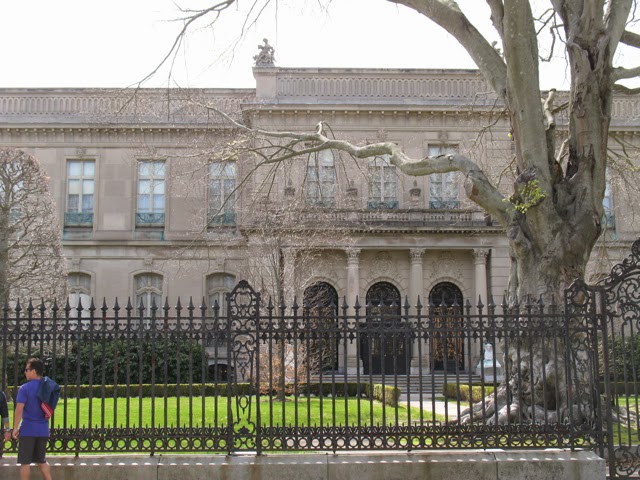
I just visited Newport and boy are the houses there amazing.  It's funny to eschew the capitalist obsession with wealth accumulation and yet still be enchanted by the palaces of kings and queens in England or the historic houses of America's tycoons. But it really is easy to enjoy the architectural splendors of earlier times.

Chateau-Nooga. Queen Anne Revival, George Browne Post, 1881. C.C. Baldwin, railroads, d. 1897.

"Vinland" Mansion. Romanesque Revival Style, Peabody & Stearns, 1882. Catherine Lorillard Wolfe, real estate and philanthropy, d.1887.

Isaac Bell House. American Shingle Style, McKim, Mead & White, 1883. Isaac Bell Jr., cotton broker, d. 1889

In Newport, the homes -- true mansions -- were built during the Gilded Age by those who earned their fortunes in banking, manufacturing, oil, railroads, steel, and other burgeoning industries.
Without exception, these great homes from America's Gilded Age are wonderful and unique windows into a time of unprecedented change and creativity in American culture. A time when the explosive growth in technology made some wealthy and promised a utopia where individuals could develop to their highest and best purpose. A time when, for many Americans, all of human history seemed to point to America and its destiny to bring Western culture to its ultimate expression. 1

De La Salle / The William Weld House.
Queen Anne-Romanesque, Dudley Newton, 1884. William Gordon Weld II, merchant and advocate for education, d.1896.

Knight Cottage "Mary Bruen House" American Shingle Style, William Ralph Emerson, 1883. Mary Bruen, widow of a Reverend, d.1886.

Osgood-Pell House. Romanesque Revival, Harding & Dinkelberg, 1887. William H. Osgood, zinc fortune, d.1896.

The Gilded Age produced tremendous economic inequality, in part, because taxes weren't levied on income. Today, we are very much in a "Second Gilded Age" -- one where income inequality exists, in part, because earnings from 'gambling' on the stock market are not taxed as income. 2

I certainly appreciate folks such as Bill and Linda Gates for their tremendous charity and commitment to philanthropy. And Warren Buffet, who sits at #2 right after the Gateses on the list of 400 richest Americans, has professed that “the proceeds from all Berkshire shares I still own at death are to be used for philanthropic purposes.” There are likely many others with a strong philanthropic focus but how many of these new billionaires will leave behind something to rival the design traditions of the late-19th century? How many will only embrace the effective altruism movement and not see value in arts and culture?

It's not that I want rich people running around building crappy McMansions, but there is something to be said for leaving things behind, physical things of aesthetic and cultural value, that can represent the hopes and aspirations, dreams and dreads, of an era. So let us then admire and be uplifted by the architectural marvels of the past of: Beaux Arts, Châteauesque, Classical Revival, Italian Renaissance, Queen Anne, Shingle Style, and Tudor Revival.


Ochre Court.  Châteauesque, Richard Morris Hunt, 1892.  Ogden Goelet, banking / real estate, d. 1897

Rough Point. English Manor Style, Peabody & Stearns, 1892. Frederick William Vanderbilt, railroads, d.1938.


The Breakers. Italian Renaissance Style, Richard Morris Hunt, 1895. Cornelius Vanderbilt II, railroads, d.1899

The ElmsBeaux-Arts style, Horace Trumbauer, 1901. Edward Julius Berwind, coal baron, d.1938.

1. http://www.flaglermuseum.us/history/gilded-age
2. http://www.nybooks.com/articles/archives/2014/may/08/thomas-piketty-new-gilded-age/

2. http://www.nytimes.com/2007/07/15/business/15gilded.html?pagewanted=all&_r=0